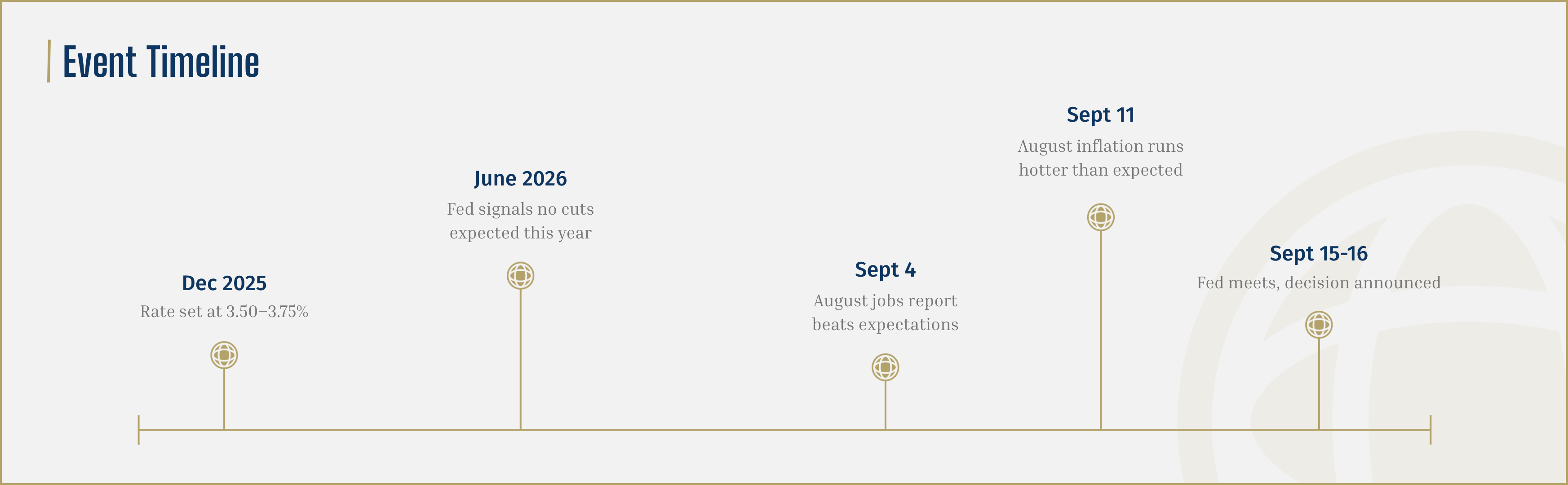
The Federal Reserve meetings start tomorrow, September 15th, and a rate increase now looks like the most likely outcome. The Fed has kept its main interest rate between 3.50% and 3.75% since December 2025, through five meetings in a row. But the two reports that were going to decide this, the August jobs report and the August inflation numbers, have both come in, and both pointed the same direction: toward a hike.
This still isn't about guessing with total certainty what the Fed will do. The decision hasn't happened yet. But the odds have shifted a lot, and it's worth understanding what changed and what each outcome would actually mean for you.
Why This Meeting Is Different From What You've Been Hearing All Year
A year of standing still, not cutting
If you've had the sense that the Fed was supposed to be cutting rates by now, you're not wrong to think that. Rate cuts were the big story through late 2025. But 2026 has actually been a year of the Fed holding steady. Every meeting this year has ended the same way, rates unchanged at 3.50% to 3.75%. Back in June, the Fed even said it didn't expect to cut rates at all this year, which surprised a lot of people who were still expecting cuts.
What changed: two reports that both leaned the same way
Two things needed to happen before this meeting, and both already have. The August jobs report came out on September 4, and it beat expectations by a wide margin: the economy added 162,000 jobs, far more than the roughly 53,000 that had been expected. On top of that, July's earlier report, which had looked weak, was revised upward too. A strong jobs report usually sounds like good news, and it is, but in this specific moment, it actually made a rate hike more likely, because it means the Fed has less reason to worry about protecting a weakening job market.
Then on September 11, the August inflation report came out. Prices were up 3.4% from a year earlier, the same as the prior reading, but the more closely watched "core" number, which strips out food and energy, actually came in a bit hotter than expected. Gas prices alone jumped nearly 4% for the month. Put together, neither report gave the Fed a clean reason to hold steady.
Why the odds shifted so fast
As of just a few weeks ago, markets saw this meeting as close to a coin flip, with roughly a 45% chance of a hike. After these two reports, that number has climbed sharply, with most measures now putting the odds of a rate hike above 80%. That's a big move in a short window, and it reflects how much weight these last two reports carried.
If the Fed Raises Rates: What It Actually Touches
Business loans and credit lines
Interest rates on many business loans and credit lines move up and down along with the Fed's rate. If the Fed raises its rate by a quarter point, borrowing costs on this kind of debt usually go up by about the same amount, and fairly quickly. If you have a variable-rate loan or a credit line you might use soon for equipment, expansion, or a business sale, this is where a rate hike would show up first.
What doesn't move the same way: mortgages
Home loan rates work differently. They're tied more closely to long-term government bond rates than to the Fed's rate directly. In fact, the average 30-year mortgage rate has already climbed to around 6.7% recently, moving somewhat on its own, separate from what the Fed decides this week. That means it's entirely possible for the Fed to raise rates and mortgage rates to stay roughly where they are, or move for entirely different reasons.
The one upside: savings and CDs
If there's a bright side to a rate hike for someone with money in savings, this is it. Savings accounts and CDs have been paying good rates all through 2026 because the Fed has held steady instead of cutting. A hike would likely keep those good rates around a bit longer, which is a real, if small, win if you're holding cash right now.
If the Fed Holds Steady: What Changes
(and What Doesn't)
A hold isn't the likely outcome, but it's still possible
Even with the odds leaning heavily toward a hike, a hold is still on the table. If it happens, it would mean the Fed is choosing to wait for more evidence, even after two reports that leaned the other way. Either way, the debate between inflation risk and job market risk carries into the next meetings in October and December, both still in play.
Waiting has a cost too
If you're a business owner deciding whether to refinance now or wait, or you're deciding whether to lock in a CD rate today, this week's decision matters either way. That's worth saying plainly: waiting isn't free. It has a cost too, even if that cost is harder to see.
The Real Question Isn't Which Way the Fed Moves
The more useful question isn't whether the Fed raises rates or holds steady this week. It's whether your plan already assumes one of those outcomes without you realizing it. A business with a variable-rate credit line and no idea what a rate increase would cost in real dollars has a plan built on a guess, not on solid ground. A retiree with a savings plan that only works if rates stay exactly where they are has the same problem, just in a different shape.
This is really the same idea behind good financial planning in general: does your plan hold up when something outside your control changes, or does it quietly depend on one specific thing happening? A few questions are worth thinking through this week, no matter which way this goes. How much of your debt has a rate that can move, and what would a small increase actually cost you? If you're holding cash and waiting to decide something, what is that waiting costing you? If you have a business sale or big financial move already in progress, does it depend on today's rates staying the same?
You don't need to guess the Fed's next move correctly to answer these questions well. What you actually need is a plan that still works even if your guess turns out to be wrong.
Frequently Asked Questions
As of the Fed's last meeting in July 2026, its main interest rate is set between 3.50% and 3.75%, where it has stayed since December 2025.
The Fed's meeting runs September 15–16, 2026, with the decision announced on September 16 at 2:00 PM Eastern time.
Not directly. Mortgage rates are tied more closely to long-term government bond rates, so they can move differently than the Fed's own rate. The average 30-year mortgage rate has already moved up on its own this year.
Many business loans and credit lines have rates that move up and down with the Fed's rate. If the Fed raises rates by a quarter point, borrowing costs on this kind of debt usually go up by about the same amount.
Two reports came out right before the meeting, and both leaned the same direction. The August jobs report came in much stronger than expected, and the August inflation report showed prices still running hot. Together, they pushed the odds of a hike from close to a coin flip a few weeks ago to a strong likelihood heading into the meeting.
A rate decision is one moment in time. What determines how it affects you is the plan you already have in place before that moment arrives, and that's worth looking at no matter which way this week's meeting goes.
Not sure how a rate move would touch your specific situation? Let's walk through it together.
See If We're a FitThis content reflects market conditions, economic data, and other information available as of the date of publication and discusses a Federal Reserve decision that had not yet occurred at the time of writing. Economic conditions, market data, Federal Reserve actions, and other relevant factors are subject to change without notice. Any forward-looking statements, forecasts, probability estimates, or opinions expressed herein are based on assumptions and information available at the time of publication and may not reflect actual outcomes. The information provided is for informational purposes only and should not be relied upon as current after the publication date. The firm undertakes no obligation to update, revise, or supplement this content to reflect subsequent events, changes in market conditions, or the occurrence of anticipated or unanticipated developments, even if the information becomes inaccurate or incomplete.
No client or potential client should assume that any information presented or made available on or through this blog should be construed as personalized financial planning or investment advice. Personalized financial planning and investment advice can only be rendered after engagement of the firm for services, execution of the required documentation, and receipt of required disclosures. Please contact the firm for further information.
Advisory services offered through Three Sixty Wealth Management, LLC an SEC registered Investment Advisor. Registration with the SEC does not imply a certain level of skill or expertise. Additional information about Three Sixty Wealth Management, LLC is available in its current disclosure documents, Form ADV, Form ADV Part 2A Brochure, and Client Relationship Summary report which are accessible online via the SEC's investment Adviser Public Disclosure (IAPD) database at adviserinfo.sec.gov/firm/summary/301007. Three Sixty Wealth Management, LLC does not offer or provide legal advice. Please consult your attorney for such services.